Key Thinkers: Thomas Aquinas
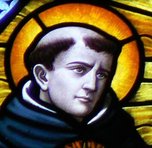
|
The medieval saint and philosopher Thomas Aquinas set out the philosophy behind the Christian faith (or at least, the Catholic version of it) in his Summa Theologica. In particular, he presents '5 Ways' (quinquae viae) of proving the existence of God.
The first 4 Ways are variations of the Cosmological Argument and the 5th is the Teleological (Design) Argument. Most of Aquinas' arguments are based on those of the Ancient Greek philosophers Aristotle and Plato. |
ARGUMENT FROM MOTION (EX MOTU)
P1 Everything in the world is moving or changing.
P2 Nothing can move or change itself.
P3 There cannot be an infinite regress of things changing other things
C1 There must be a first changer (a Prime Mover)
C2 The Prime Mover is God.
P2 Nothing can move or change itself.
P3 There cannot be an infinite regress of things changing other things
C1 There must be a first changer (a Prime Mover)
C2 The Prime Mover is God.
Aquinas is concerned more with changes of state than with 'motion' in the sense of things moving about. His idea is that everything in the world has potential to change - or has actually changed. For example, wood has the potential to burn and when you set fire to it, it actually burns. Everything needs something outside itself to activate its potential (like wood needs a match or a stroke of lightning).
This creates an infinite regress of things changing other things, which Aquinas thinks is impossible.
This creates an infinite regress of things changing other things, which Aquinas thinks is impossible.
The chain of movers cannot go on to infinity because then there would be no first mover and consequently no other mover - Thomas Aquinas
The alternative to infinite regress is a First Mover (sometimes called a Prime Mover or an Unmoved Mover). The point about God is that he is supposed to be changeless, so if God is the First Mover he doesn't need anything to actualise his own potential.
ARGUMENT FROM CAUSATION (EX RATIONE CAUSAE EFFICIENTIS)
P1 Everything in the world has a cause
P2 Nothing causes itself
P3 There cannot be an infinite regress of causes
C1 Therefore there has to be a First Cause to start it all
C2 The First Cause is God.
P2 Nothing causes itself
P3 There cannot be an infinite regress of causes
C1 Therefore there has to be a First Cause to start it all
C2 The First Cause is God.
Aquinas uses Aristotle's idea of efficient causes (previous events that make things happen). There is a sequence of efficient causes in the observable world. We have no experience of anything that is the cause of itself. In fact, for something to cause itself, it would have existed prior to itself, which is impossible. But Aquinas believes an infinite regress of causes is impossible because, without a cause to start the process, there would be no effects. But this is false because we have experience of cause and effect. Aquinas concludes there must be a First Cause (or Uncaused Cause). The point about God is that he is uncaused.
Both of these arguments have the same structure. They make an observation about the world that requires an infinite regress to explain it, then reject infinite regress as impossible. They propose God instead, as an alternative to infinite regress.
ARGUMENT FROM CONTINGENCY (EX POSSIBILI ET NECESSARIO)
P1 Everything in the world is contingent (it can either exist or not)
P2 If things exist, there must be some time when they didn't exist
C1 There must have been some time when NOTHING existed
P3 Things exist now
C2 There must be something that everything depends on for its existence - something that ensures everything else exists but is itself necessary (not contingent)
C3 This Necessary Being is God.
P2 If things exist, there must be some time when they didn't exist
C1 There must have been some time when NOTHING existed
P3 Things exist now
C2 There must be something that everything depends on for its existence - something that ensures everything else exists but is itself necessary (not contingent)
C3 This Necessary Being is God.
Everything in the world has contingent existence, which means that it could easily not have existed at all. Things depend for their existence on other things. This creates the possibility of nothing existing. Yet the world clearly does exist, which suggests that not everything is contingent - something is Necessary and must exist. This Necessary Being is God
This argument takes the form of a reductio ad absurdum. Aquinas starts thinking about contingency and draws the conclusion that the universe shouldn't exist at all - which is absurd. So he has to challenge one of his premises - the idea that everything is contingent. In order the explain the existence of the universe, there must be something that is non-contingent (Necessary) for everything else to depend upon.
ARGUMENT FROM DEGREE (EX GRADU)
Many philosophers consider this to be a Cosmological Argument too, but it's rather different in approach and isn't usually treated as one of the 'classic' Cosmological Arguments. Aquinas makes an observation about the qualities of things. For example, some things are more beautiful than other things. One has a greater degree of beauty than the next. This is referred to as degrees of quality (or value judgments). Aquinas concludes that for any given quality (e.g. goodness, beauty, knowledge), there must be a perfect standard by which all such qualities are measured. These perfections are contained in God.
Maybe you feel that "beauty is in the eye of the beholder" - it's just a personal preference and doesn't require a perfect standard. If our value judgments really are SUBJECTIVE, then Aquinas' argument loses its persuasiveness. However, there are problems with regarding value as being subjective, which will be considered in the Ethics course.
This 8 minute video explores what Aquinas' arguments have in common but focuses on the 3rd Way
Aquinas' arguments (especially the first 3 Ways) have been very influential. It is Aquinas' arguments that David Hume and Immanuel Kant are criticising. In the 20th century, Bertrand Russell and J.L. Mackie built on these criticisms, but Frederick Copleston refined the 3rd Way in his own Cosmological Argument.
Has Aquinas made a successful Cosmological Argument?
Has Aquinas made a successful Cosmological Argument?
|
YES
Aquinas' arguments go to the heart of the Cosmological Argument, which is the idea of contingency. We are forced to choose between an infinite regress (which would involve the universe not existing at all - which is clearly wrong) or some sort of Being which doesn't obey the normal laws of nature: a Being that is changeless, uncaused, non-contingent and perfect. It's perfectly reasonable to identify this Being with the God of religion.
Aquinas' arguments also support our belief in logic and science. He believes we can find out what the universe is really like. We are right to recognise cause-and-effect in things and to explore this causality and work back to find the origins of the universe. This is exactly what science does. Critics who insist the universe is a brute fact are like passengers jumping out of a taxi before paying the fare - the Taxicab Fallacy.
|
NO
Aquinas is too quick to identify 'God' as the changeless or uncaused thing. Why does it have to be the God of religion? Isn't it possible that the universe itself is unchanging and uncaused? Saying that the universe must have a cause because everything inside it has a cause is committing the Fallacy of Composition. The universe could be a brute fact - something that needs no further explanation.
Aquinas is too simplistic. He never gives serious consideration to the possibility of a universe that is infinitely old. Although scientists today support the "Big Bang" Theory, they accept the possibility of another explanation and we may go back to the older idea of an infinite universe. Scientists tell us it is wrong to suppose that cause-and-effect works in the same way at the 'singularity' of the "Big Bang". We should accept there may be limits to what the human mind can understand.
|
